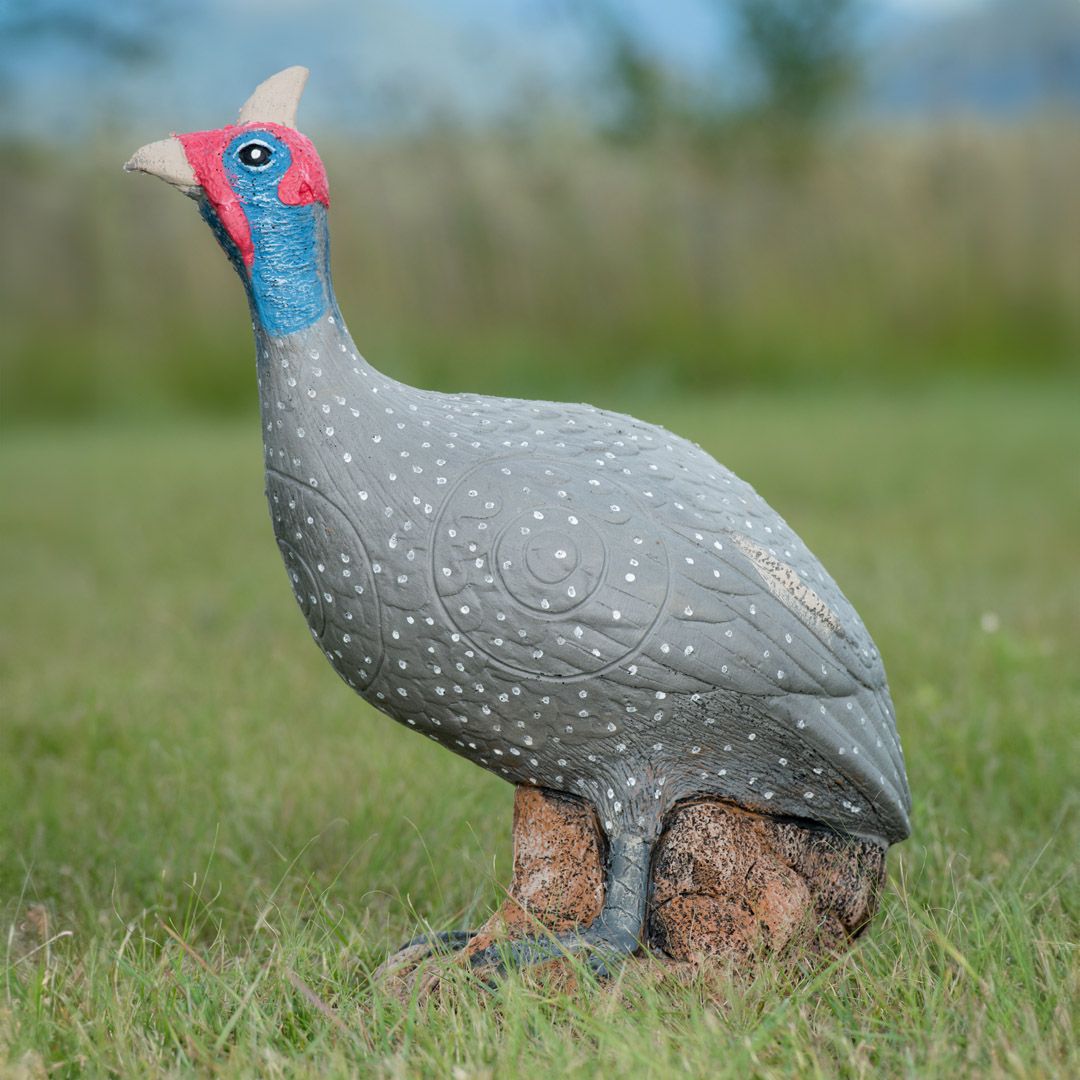
Wildcrete 3D Target - Guinea Fowl
Wildcrete 3D Target - Guinea Fowl
At a glance
- Authentic 3D design for exciting course stations
- Clearly marked scoring areas for controlled training
- Suited to structured scoring and course scenarios
- Striking target design for more variety in your shooting
- Due to production challenges at Wildcrete, we currently expect the next goods receipt to arrive in the last quarter of this year. Thank you for your understanding.
- Depending on the item and quantity, shipping costs may apply and will be invoiced separately.
Couldn't load pickup availability
 Faster & safer shipping
 14-day return policy
They are endemic to Africa and rank among the oldest of the gallinaceous birds.
Phylogenetically, they branched off from the core Galliformes after the Cracidae and before the Odontophoridae (New World quail).
An Eocene fossil lineage Telecrex has been associated with guineafowl; Telecrex inhabited Mongolia, and may have given rise to the oldest of the true phasianids, such as blood pheasants and eared pheasants, which evolved into high-altitude, montane-adapted species with the rise of the Tibetan Plateau. While modern guineafowl species are endemic to Africa, the helmeted guineafowl has been introduced as a domesticated bird widely elsewhere.
Dimensions:
(H) 303 mm
(L) 236 mm
(W) 223 mm
Weight:
1.5 kg
Scoring Zones:
2 broadside shots
1 frontal shot
Group 4
Product description
Guineafowl are birds of the family Numididae in the order Galliformes.
They are endemic to Africa and rank among the oldest of the gallinaceous birds.
Phylogenetically, they branched off from the core Galliformes after the Cracidae and before the Odontophoridae (New World quail).
An Eocene fossil lineage Telecrex has been associated with guineafowl; Telecrex inhabited Mongolia, and may have given rise to the oldest of the true phasianids, such as blood pheasants and eared pheasants, which evolved into high-altitude, montane-adapted species with the rise of the Tibetan Plateau. While modern guineafowl species are endemic to Africa, the helmeted guineafowl has been introduced as a domesticated bird widely elsewhere.
Dimensions:
(H) 303 mm
(L) 236 mm
(W) 223 mm
Weight:
1.5 kg
Scoring Zones:
2 broadside shots
1 frontal shot
Group 4
Shipping & returns
-

Tips & Tricks
TO THE BLOGAre you looking for more information about archery? Check out our blog for useful tips.
-

Where can I practice archery?
DISCOVER NOW!Where can you go archery, either alone or with your loved ones? We’ve got the answer: Discover BEARPAW COUNTRY!
-

Typical Archery Terms
CHECK IT OUT NOWDo you want to further your knowledge and understand more about archery? In our glossary, we explain the typical terms.